New OVA and QCOW2 images let teams evaluate ZSvirt inside existing VMware or KVM environments without a dedicated server, while new technical resources and an MCP Server broaden community access.
SHANGHAI, Sept. 2, 2026 — Two weeks after open-sourcing enterprise virtualization platform ZSvirt, ZStack today announced new OVA and QCOW2 virtual appliance images that can launch a working evaluation environment in approximately five minutes. Teams can import the images into an existing VMware or KVM environment without first preparing a dedicated physical server.
As of Aug. 27, ZSvirt had received more than 1.4K GitHub stars, 283 forks and 78 watchers. On Trendshift, it reached No. 1 among Java repositories of the day, No. 21 across all languages on Aug. 16, and No. 2 among Java repositories for week 34.
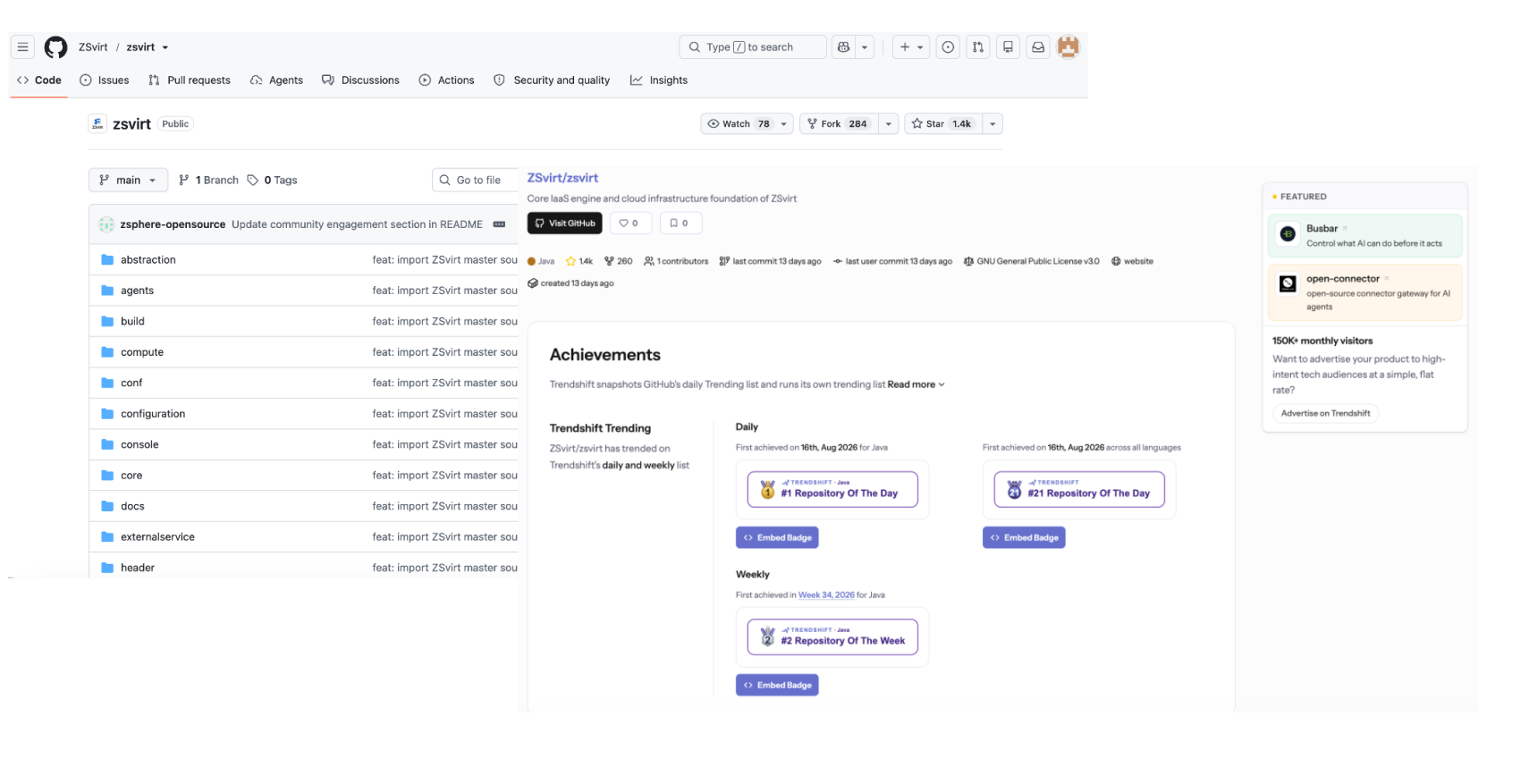
Those figures reflect early interest in the project. More importantly, developers and infrastructure professionals have begun installing, comparing and examining the platform, raising questions about its architecture, management model and VMware migration options.
One question surfaced repeatedly: Should a team have to set aside a physical server before deciding whether ZSvirt is worth a formal proof of concept?
Run it first, then decide whether to start a PoC
Previously, a first ZSvirt evaluation generally involved preparing a server, mounting the ISO, completing installation, and initializing the management node, storage and networking. That path remains available for bare-metal deployment, but it requires hardware and staff time before a team has formed an initial view of the platform.
The new OVA and QCOW2 images lower that barrier. Teams can import the OVA image into an existing vSphere environment or use the QCOW2 image in a KVM environment, launch ZSvirt in approximately five minutes, and review its interface, resource model and basic workflows before committing separate hardware to a PoC.
The images do not replace the ISO. They separate early evaluation from production deployment. The download center now provides ISO, OVA, QCOW2 and ZMigrate packages, each accompanied by a SHA256 checksum. The open-source edition does not require a separate migration-tool license.
The community has started testing the technical story
The project’s early visibility has also prompted questions about how ZSvirt relates to other virtualization platforms.
ZSvirt is not an OpenStack derivative. Its core engine comes from ZSphere, ZStack’s commercial virtualization platform, and follows a technical path independent of VMware and OpenStack. Related capabilities have operated in more than 1,000 production environments across industries including financial services, healthcare, education, manufacturing and transportation.
During the first two weeks, a network and security consultant introduced ZSvirt and its online demo on LinkedIn. Quora users compared its unified management model with VMware and Proxmox. A GitHub Trending channel with more than 60,000 subscribers also featured the project.
These discussions brought more specific questions about host management, agent deployment and workload migration. For a newly open-sourced infrastructure platform, that kind of examination is more useful than attention alone.
Beyond source code
Source code by itself does not tell an infrastructure team how to install a platform, why it was designed in a particular way, or how to move existing workloads onto it.
During the two weeks following the release, ZSvirt added deployment guidance, an architecture overview and VMware migration resources. The materials cover minimum installation, troubleshooting, core design principles, and migration through ZMigrate, OVF import or VMDK upload.
The current release limits concurrent online migrations, with that limit planned to be relaxed in subsequent releases. Offline virtual machine imports are not subject to the same limit.
ZSvirt also provides more than 2,000 APIs, multiple SDKs and a Terraform Provider, enabling integration with existing operations and infrastructure-as-code workflows.
Extending the platform toward AI-assisted operations
Another update is the addition of the ZSvirt MCP Server to the project’s official open-source organization.
Built on the Model Context Protocol, the project is designed to help AI agents find and use ZSvirt APIs and monitoring data on demand without loading the complete interface catalog into a model’s context.
The MCP Server remains at an early stage, and its capabilities will continue to evolve. It extends ZSvirt’s API-first approach by making the same open interface foundation available to user interfaces, SDKs, automation tools and AI agents.
The next goal is real-world use
ZSvirt is released under GNU GPL v3.0 and is available for production use with no license fee. Its source code, installation images and migration tooling are publicly available.
The project’s next goal is not simply more visibility, but feedback from real environments: whether installation works as expected, whether the images import successfully, what happens during migration, and which capabilities are still missing.
Teams can begin with an OVA or QCOW2 image, inspect the source on GitHub, and share installation, migration and feature feedback with the project team and community on Discord.
Two weeks ago, ZSvirt opened its source code. The work now is to make it easier for more people to run, examine and improve it.
● Repository: https://github.com/ZSvirt/zsvirt
● Community Site: https://zsvirt.io
● Discord: https://discord.gg/KHsw63z9xA
About ZStack
Founded in 2015, ZStack is a cloud infrastructure software provider serving more than 5,000 enterprise customers across over 30 countries and regions. Its portfolio spans virtualization, private cloud, hyperconverged infrastructure, distributed storage and AI infrastructure. ZStack is listed as a Representative Vendor in the Gartner Market Guide for Server Virtualization Platforms.
Media Contact
ZStack
Rainsy Ge
Email: xinyu.ge@zstack.io
Phone: +86 150 0057 9204
Location: Shanghai, China